
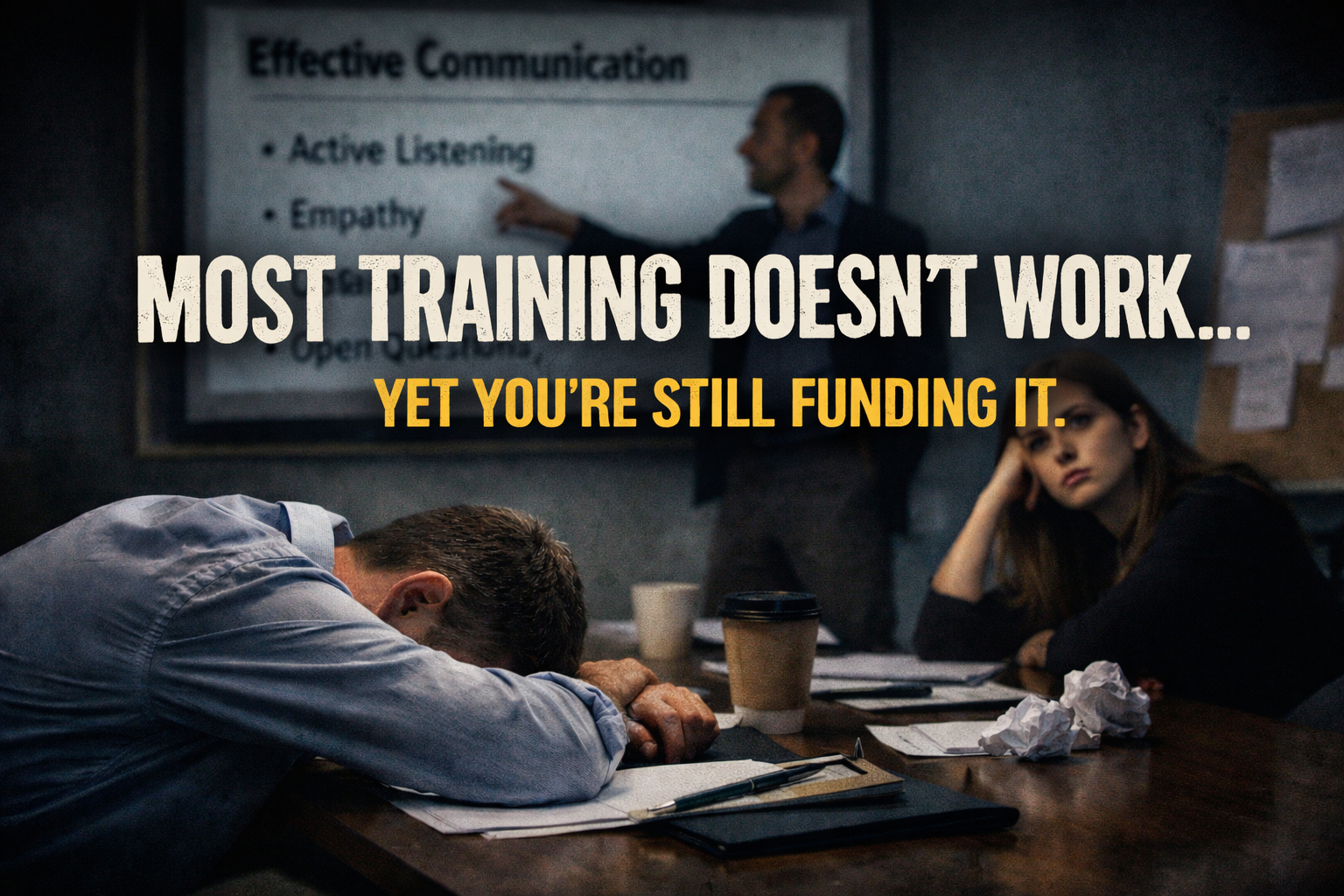
Most training doesn’t work… yet you’re still funding it.
We’ve all been in that room.
Half decent coffee, a page with well intentioned notes. Slide 7 of 83. Someone explaining a model you could have read in a book. You glance at the slide counter and work out how long is left before you can get back to actual work.
At the end of the day, you’ve had a nice time and the feedback forms look healthy. People describe it as “useful”. The trainer is engaging. Everyone leaves with good intentions.
Then, three weeks later, nothing much has shifted.
This is not just cynicism. Research has been flagging the problem for decades. One of the most widely cited reviews of training transfer, by Baldwin and Ford (1988), concluded that a significant proportion of
training simply does not translate into sustained behavioural change back in the workplace. Even decades later, the message is consistent: without reinforcement and practice, transfer is patchy at best.
The pattern is familiar.
Most programmes focus heavily on content. They explain what good looks like and provide frameworks. They may even include discussion about real scenarios. What they rarely include is enough rehearsal under pressure or the ability to see exactly what you looked like when you were stumped, how you sounded when your feedback was met with anger or how your sales pitch floundered.
When a leader or people manager has to challenge poor performance. When a director has to push back on a demanding client. When a manager has to deliver tough upward feedback. In that moment, people do not retrieve the slide deck, they default to habit.
There is a reason Anders Ericsson’s research on deliberate practice showed that expertise develops through focused repetition, immediate feedback and correction. Explanation alone does not rewire behaviour. Practice does.
Think back to when you learned to drive. Sure, you could read the Highway Code from cover to cover and memorise the stopping distance in the wet from 60mph (146m if you’re interested!) but nothing prepared you for being soaked in sweat following your first time out on the road or the intricate balance required between accelerator and clutch before you could even get moving!
We failed. We made mistakes. The only way to get better was to have someone there at the start telling us what to do and, later, spotting the small improvements that would make life easier (and probably longer).
If your development strategy stops at knowledge or insight, you are relying on hope. And hope is not a method.
The uncomfortable questions are these: does your training deliver attendance and satisfaction, or does it deliver observable shifts in behaviour weeks later, when it actually counts?
And does the person’s performance actually improve…whatever that looks like for them.