
How Self Aware Are You Really?
You’re not as self-aware as you think. That is not a clever opener. It is statistical probability.
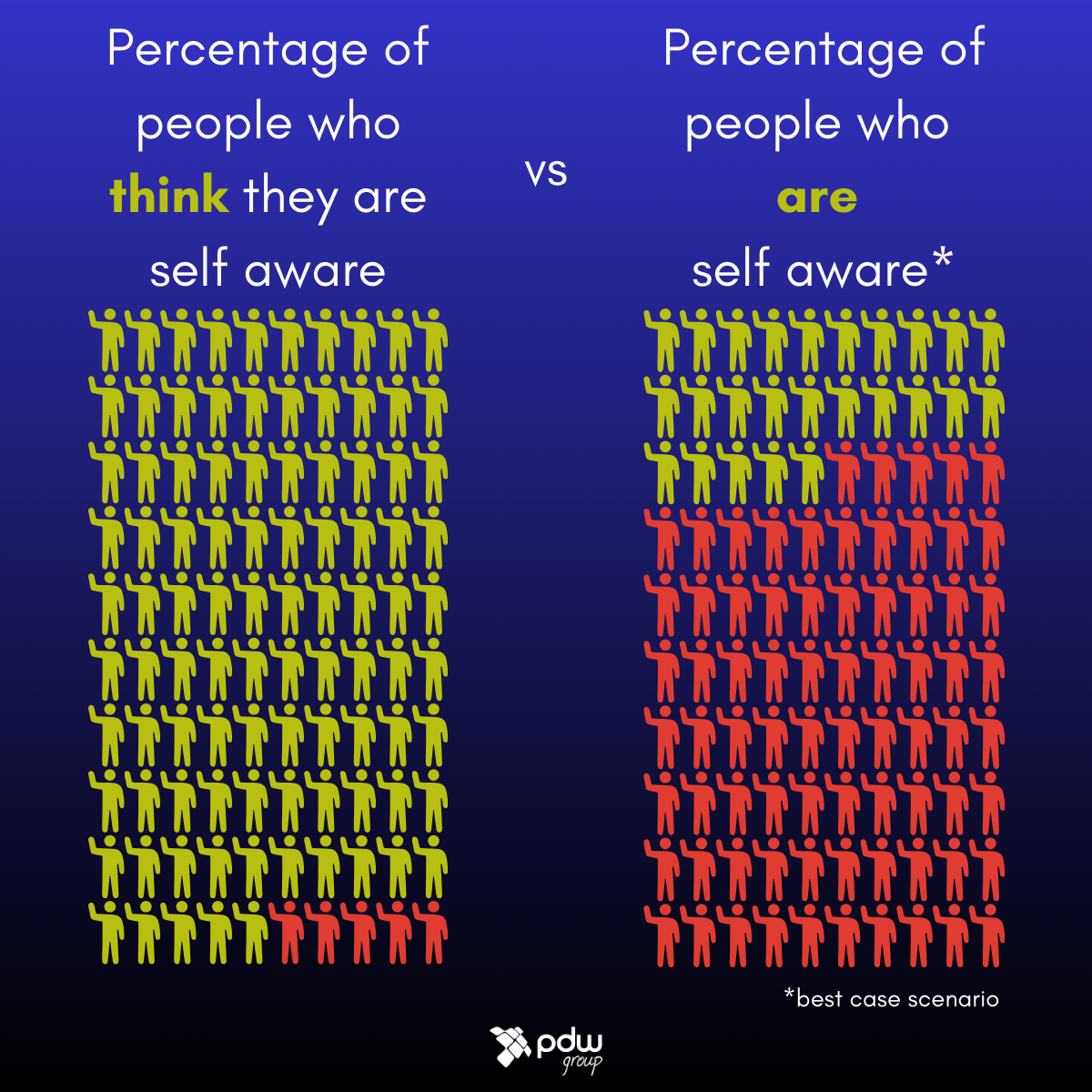
Research by organisational psychologist Tasha Eurich, published in the Harvard Business Review, found that 95% of people believe they are self-aware. In reality, only around 10–15% meet the criteria. In a nutshell, that means that most of us are walking around with an inflated view of how we are perceived by other people.
The real danger is not incompetence; it is confidence. The longer someone has been ‘successful’, the easier it is to assume that their impact is broadly positive and broadly understood. So feedback gets filtered and patterns go unchallenged. A personal narrative hardens: this is just how I am.
Inside organisations, ‘unintended outcomes’ happen frequently, daily in fact, and that gap between intention and impact is expensive.
We have seen leaders & people managers who genuinely believe they are clear and empowering, yet their teams leave meetings unsure what good looks like and reluctant to admit it. We have worked with partners who are convinced they are approachable, while colleagues quietly navigate around them thinking “there’s no point in asking them”.
Equally we have worked with many sales people & customer facing people who believe they are great at what they do because they can talk about their product all day long…but they just don’t realise how much more of a positive relationship and commercial impact they could have if they were more self
aware and applied some purposeful ‘technique’.
None of this shows up on a balance sheet in neat columns, but it slows decisions, creates duplication and erodes trust.
This is also why most training doesn’t work.
People sit through theory, recognise themselves in a model and feel validated. Insight is mistaken for change. No one tests how they behave when challenged. No one feels the pressure of a real conversation. No one has to confront how they actually come across and the impact they have on others, whether these are colleagues, direct team members, customers or prospects.
Recently, I was working with two experienced professionals who opened the day by saying they were open to it but had “been doing this a long time, so I’m not sure what I’ll learn”.
Fair enough.
Two days later, they had watched themselves back on camera after practising difficult conversations in a controlled but realistic setting. The shift was visible. Tone they thought was clear came across as clipped. Questions they believed were open were leading, and the hooks they chose not to explore were left hanging.
First, there were uncomfortable moments; then there were lightbulb moments. They began connecting the dots between strained relationships at work and how they showed up under pressure. They spoke honestly about how a lack of self-awareness may have shaped parts of their career trajectory. By the end, the conversation had moved beyond clients and colleagues to partners and children at home.
Once you see the gap between who you think you are and how you are actually perceived, it becomes hard to ignore.
Experience on its own does not guarantee genuine influence. Neither does seniority. In fact, both can insulate you from challenge if you are not careful.
Self-awareness is built when you expose your behaviour to scrutiny, invite honest feedback and practise adjusting it in real time and keep your eyes and ears ‘on’. That is rarely comfortable. It is, however, far more reliable than trusting your own internal commentary.
The statistic is interesting.
The more important question is whether you are prepared to test on which side of it you fall.